
Indian benchmark indices, Sensex and Nifty, experienced subdued trading and turned flat on Tuesday as investors engaged in profit-booking following a recent rally, compounded by weak Asian market trends and fresh foreign fund outflows.

Indian benchmark indices Sensex and Nifty continued their upward trend for a second consecutive day, with the Sensex gaining over 800 points, driven by strong performances from heavyweights like Reliance Industries, ICICI Bank, and HDFC Bank, alongside positive cues from easing crude oil prices and robust IT sector earnings.

Executive Director V Vaidyanathan will assume the position of managing director and chief executive officer of the bank's life insurance arm, ICICI Prudential. This slot had fallen vacant as Shikha Sharma decided to move to Axis Bank.

Reliance Industries was the biggest gainer in the Sensex pack, rising 2.69 per cent, followed by HCL Tech, ICICI Bank, Tata Motors, Wipro, IndusInd Bank, JSW Steel, Wipro, Tata Consultancy Services and Titan. In contrast, NTPC, Power Grid, UltraTech Cement, Axis Bank, Infosys and Nestle were the major laggards.

Indian benchmark indices Sensex and Nifty closed flat, paring early gains due to renewed hostilities between the US and Iran, which unsettled investor sentiment and led to profit booking in metal, oil & gas, and telecom shares.

Former ICICI Bank veteran Shikha Sharma will take home a hefty pay packet as Axis Bank managing director and CEO that will be in excess of Rs 2 crore (Rs 20 million) a year, if one counts allowances and other perquisites.
The aim of the department is to check suspected tax evasion by the banking institutions and possible loss of revenue by illegal acts done by authorised individuals.

What is the reason behind this drying up of talent for the top post in private banks?

Banks and NBFCs are launching festival offers, including lower loan rates, cashback, EMI schemes and GST-linked benefits to tap rising demand ahead of Diwali

Indian benchmark equity indices Sensex and Nifty closed higher, recovering from previous losses, driven by a global market rebound, a pause in Israel-Iran hostilities, and a rally in bank stocks.

ICICI Bank was the biggest loser in the Sensex pack, slipping 2.81 per cent, followed by Mahindra & Mahindra, State Bank of India, UltraTech Cement, IndusInd Bank, Kotak Mahindra Bank, Tata Motors, Bajaj Finserv, Axis Bank and Power Grid. Tech Mahindra, Bharti Airtel, Infosys, Asian Paints, Hindustan Unilever, Larsen & Toubro and Titan were the gainers.

Indian stock markets witnessed a significant rally, with the Sensex climbing 964.58 points and the Nifty reaching 24,330, driven by strong buying in blue-chip stocks, particularly in the IT and banking sectors, amidst optimism over Q1 earnings and a shift towards large-cap investments.
US bank Citigroup on Wednesday announced the sale of its Indian consumer banking businesses, including credit cards, retail banking, wealth management and consumer loans, to private lender Axis Bank for Rs 12,325 crore, as part of its plans to exit retail operations in 13 markets.

Banking operations at public sector banks across the country were impacted on Tuesday as the United Forum of Bank Unions (UFBU) went on nationwide strike demanding the immediate implementation of a five-day work week.

Indian benchmark indices Sensex and Nifty experienced a decline due to renewed geopolitical concerns in the Strait of Hormuz, a strained US-Iran ceasefire, and the rupee hitting a record low against the US dollar.

SBI was the top loser in the Sensex pack, shedding around 3 per cent, followed by Bajaj Finserv, Tech Mahindra, Sun Pharma, Bajaj Finance and Axis Bank. Nifty fell 143.60 points to 17,873.60.
The step followed Reserve Bank Governor Raghuram Rajan's hard talk.

Sectoral funds, focused exclusively on public sector banks (PSBs), have delivered the strongest returns among domestic mutual fund (MF) categories over the past six months. However, active banking funds have significantly lagged because of their heavy tilt towards private lenders.

Indian equity benchmark indices Sensex and Nifty rallied in early trade, driven by reports of a second round of talks between the US and Iran, which are fostering hopes for a resolution to the West Asia conflict, coupled with Brent crude oil prices trading below the USD 100 per barrel mark.
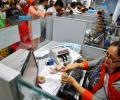
Indian bank credit expanded by 16.08 per cent year-on-year in FY26, marking its fastest pace since FY24, while deposits grew by 13.47 per cent, according to RBI data. Experts caution that year-end figures may be inflated due to reporting date changes, but acknowledge strong momentum in corporate, MSME, and retail segments.

Since January this year, RBI has cut the repo rate - at which it lends to commercial banks -- to a gross of 1.25 per cent.

India's private-sector banks are likely to lose market share for a second consecutive year in 2025-26, as their loan books continue to expand much slower than overall bank credit.
In a career spanning over 29 years, Sharma has had a wide exposure across the entire spectrum of financial services and has held several leadership positions across various market-leading businesses, the bank said in a statement. Axis Bank is the third-largest private sector bank in India and its network spans across more than 840 offices and over 3,600 ATMs.
Indian benchmark equity indices, Sensex and Nifty, extended their winning streak for a third consecutive day, driven by a rally in IT stocks and global cues suggesting a more accommodative monetary policy after softer-than-expected US jobs data.
Indian stock markets extended their gains for a third consecutive day, with the Sensex climbing 753 points and the Nifty closing above 24,550, driven by a drop in crude oil prices and optimism surrounding potential peace talks between Iran and the US.

Bharat Electronics, Bharti Airtel, HDFC Bank, Kotak Mahindra Bank, Titan and Eternal were also among the laggards from the Sensex pack. However, Bajaj Finance, Tata Steel, ICICI Bank, HCL Tech and Infosys were among the gainers.
A day after its bigger rival ICICI Bank cut its lending rate, the third-largest private lender, Axis Bank, on Friday lowered its base rate by 0.10 per cent to 9.85 per cent, effective June 30.

The charges would apply to savings as well as salary accounts

This is the first time ICICI Bank has gone for a share split.

Moody's downgraded local currency bank deposit ratings.
Benchmark equity indices Sensex and Nifty extended their gains for the second straight session on Monday, driven by optimism over the India-US trade deal and robust buying in public sector banks, consumer durables, and realty stocks.
ICICI Bank has reversed its decision to raise the minimum monthly average balance (MAB) for new savings accounts in metro and urban locations to Rs 50,000, revising it instead to Rs 15,000, effective August 1. The MAB for new savings accounts in semi-urban locations has been revised from Rs 25,000 to Rs 7,500, and for rural locations from Rs 10,000 to Rs 2,500.
Indian benchmark indices Sensex and Nifty saw a significant rebound in early trade, driven by a sharp decline in crude oil prices and easing geopolitical tensions in the West Asia, which improved market sentiment and reduced inflation fears. Track Sensex, Nifty on July 27.

The smartphone goes on sale from June 19 via Amazon and will be available in Asphalt Black, Nitro Blue and Turbo White finishes.

'She was either overconfident that nothing will happen to her or she underestimated the gravity of the allegations.'
Indian benchmark indices Sensex and Nifty rebounded in early trade, tracking a recovery in global equity markets and an easing of hostilities between Israel and Iran, after a sharp fall in the previous session.
Stock market benchmarks ended with losses for the third straight session on Wednesday as heightened geopolitical tensions, weak global peers and persistent foreign fund outflows unnerved investors.

Indian stock market benchmark indices Sensex and Nifty closed nearly one per cent higher, extending their winning streak for a second day. This rally was driven by softening crude oil prices, positive geopolitical developments, and significant buying in blue-chip IT stocks, despite a broader global tech sell-off.

From the Sensex pack, NTPC, Bajaj Finance, Kotak Mahindra Bank, Axis Bank, Nestle, Larsen & Toubro, Tata Motors, ICICI Bank, Power Grid and Zomato were among the gainers. However, Infosys, Tata Steel, Mahindra & Mahindra, Titan and Bajaj Finserv were among the laggards.

Indian benchmark indices Sensex and Nifty experienced volatility due to conflicting developments in West Asia, including reports of the Strait of Hormuz closure, which led to a rebound in crude oil prices and heightened investor concerns about supply disruptions and inflation.
